Instructional Designer vs eLearning Developer – Key Differences

You're writing a job posting or scoping a project, and the titles blur together. One company wants an "instructional designer" who builds courses in Storyline. Another wants an "eLearning developer" who writes learning objectives. A third wants both for one salary. If the instructional designer vs eLearning developer question feels fuzzy, that's because the industry uses the titles loosely. The roles themselves are distinct, though. What's the real difference between an instructional designer and an eLearning developer?
An instructional designer decides what a course should teach and how, while an eLearning developer builds that design into a working digital course. The designer analyzes the need, writes objectives, structures the content, writes scripts and storyboards, and designs assessments. The developer takes the approved storyboard and builds it in an authoring tool, adding interactions, media, programming and tracking, then publishes it for the learning management system (LMS). Many people do both, especially on small teams, but the skills are different: one is mostly about learning and communication, the other mostly about tools and technical problem-solving.
What Does an Instructional Designer Do?
An instructional designer figures out what people need to learn and designs the experience that gets them there. The field of instructional design draws on learning theory, analysis and models such as ADDIE (Analysis, Design, Development, Implementation, Evaluation).
Day to day, the work usually includes:
- Interviewing subject matter experts (SMEs) and stakeholders to understand the problem.
- Deciding whether training is even the right answer.
- Writing measurable learning objectives.
- Structuring content into modules and lessons.
- Writing scripts, on-screen text and storyboards.
- Designing practice activities, scenarios and assessments.
- Planning how to measure whether the course worked.
The core skills are analysis, clear writing, learning science and the patience to turn an expert's knowledge into something a beginner can use.
What Does an eLearning Developer Do?
An eLearning developer turns an approved design into a working course that runs reliably for every learner. They're the builders, and good ones are part craftsperson, part troubleshooter.
Typical tasks include:
- Building screens and interactions in authoring tools such as Articulate Storyline, Rise, Adobe Captivate or Lectora.
- Programming triggers, variables, states and branching logic.
- Integrating narration, video and graphics.
- Making the course accessible, from keyboard navigation to alt text.
- Publishing packages in standards such as SCORM (Sharable Content Object Reference Model) or xAPI (Experience API) and testing them in the LMS.
- Fixing bugs found in review and quality assurance (QA).
- Sometimes writing custom HTML, CSS or JavaScript for things the tool can't do on its own.
The core skills are tool mastery, visual and technical problem-solving, attention to detail and a calm approach to debugging.
Instructional Designer vs eLearning Developer: Side by Side
Here's a quick comparison of the two roles across the things people usually ask about:
| Area | Instructional designer | eLearning developer |
|---|---|---|
| Main question | What should learners do, and how will they learn it? | How do we build this so it works everywhere? |
| Key outputs | Objectives, outlines, scripts, storyboards, assessments | Built courses, interactions, published packages |
| Main tools | Word processors, slide tools, mind maps, storyboard templates | Authoring tools, media editors, LMS test environments |
| Works most with | SMEs, stakeholders, learners | Designers, media specialists, LMS administrators |
| Best background | Education, training, writing, psychology | Multimedia, web development, graphic design |
| Common frustration | Reviewers who skim the storyboard | Content changes after the build has started |
Where Do the Roles Overlap?
The roles overlap most in visual design, interaction design and rapid authoring. A designer often sketches interactions in detail, and a developer often suggests better ways to build them. Template-based tools like Rise have made it easy for designers to build simple courses themselves, which blurs the line further.
Overlap is healthy when it's a conversation. A developer who says "this drag-and-drop won't work on phones, could we use a multiple-choice scenario instead?" is improving the design. Overlap becomes a problem when nobody clearly owns a decision. If a developer quietly rewrites content to make it fit a screen, or a designer specifies interactions the tool can't do, the result is rework and frustration.
How Do the Two Roles Work Together on a Project?
The two roles work together through a series of handoffs, with the storyboard as the main bridge. A typical project runs like this:
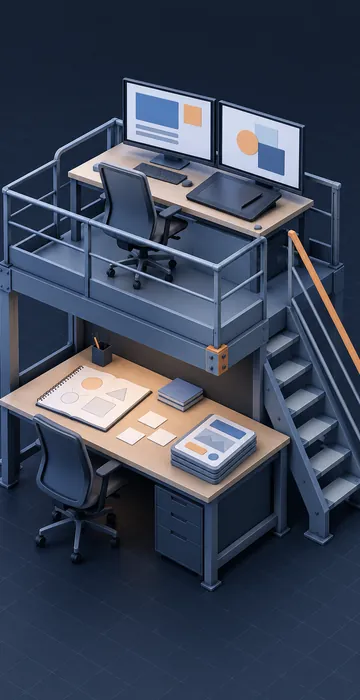
- The designer leads analysis and writes objectives. The developer may join early to flag technical limits, such as how the LMS tracks completion.
- The designer writes the script and storyboard. The developer reviews a draft for buildability before the SME sees it.
- The developer builds a prototype of any tricky interaction, and the designer checks that it supports the objective.
- After storyboard approval, the developer builds the alpha. The designer reviews it against the storyboard.
- Both handle review comments: the designer owns content changes, the developer owns functional fixes.
- The developer publishes and tests in the LMS, and the designer confirms the final course still teaches what it should.
Step two is the one teams skip, and it's one of the most valuable. Ten minutes of developer feedback on a draft storyboard can save days of rework later.
Should One Person Do Both?
One person can do both well on small, simple projects, and many people build careers as designer-developers. On larger projects, splitting the roles usually produces better courses faster.
The reason is focus. Design needs uninterrupted thinking time, long conversations with SMEs and careful writing. Development needs long stretches of building and testing. Switching between them all day slows both. A combined role also creates a single point of failure: if that one person is out, the project stops.
A practical middle ground: have one person own design and simple builds, and bring in a developer for complex interactions, custom code or peak workloads.
What Should Hiring Managers Look For?
Hiring managers should ask each candidate for evidence of the work, not just a list of tools. For an instructional designer, ask for a storyboard or design document along with the finished course, and ask them to explain why they made the choices they did. Strong designers talk about learners, objectives and the problem the course solved.
For an eLearning developer, ask for working samples you can click through, ideally including something they built from someone else's storyboard. Ask how they'd handle a bug that only appears in the LMS, or how they made an interaction keyboard accessible. Strong developers talk about testing, reliability and clean, reusable files.
If you need one person for both, look for both kinds of evidence, and be realistic about the workload you're asking them to carry.
Which Role Does Your Project Need?
Hire an instructional designer when the hard part is deciding what people need to learn: an unclear performance gap, expert-heavy content or assessments that must hold up. Hire an eLearning developer when the design is settled and the hard part is building it: interactions, simulations, tracking and publishing. If you need both and only have budget for one person, look for someone who can show you a storyboard and the finished build that came from it.
Both skill sets are easy to find on paper and harder to find in one person. The U.S. Bureau of Labor Statistics tracks related occupations, which gives a sense of how broad these jobs are across education and industry. Many professionals start on one side and learn the other over time, which makes them more valuable on any team. Some eventually go independent, either freelancing or selling online courses of their own, where knowing both sides is a real advantage. If that idea appeals to you, our look at selling online courses covers what the business side really takes.
Instructional Designer vs eLearning Developer: Two Halves of One Course
The instructional designer vs eLearning developer question comes down to design versus build. The designer decides what learners need and how they'll learn it. The developer makes that plan work on screen, in the LMS and on every device.
If you're hiring, write the job description around the work you actually need done, not the title. If you're staffing a single project, ask each candidate or vendor to walk you through one storyboard and the finished course it became, because that tells you quickly which half of the work they really do. Either way, the best courses come from teams where both halves respect each other's craft.