eLearning for Healthcare Teams – Short, Accurate and Trackable
It is hour eleven of a twelve-hour shift for a nurse on a busy medical unit. She has four patients, a family waiting for an update and a reminder that her annual training is overdue. She'll squeeze it in, probably on a shared computer at the nurses' station, probably with interruptions. That's the real setting for most healthcare eLearning, and it's very different from the quiet office many courses seem to be designed for. How do you build healthcare training that busy clinical staff can finish, that stays accurate and that holds up when an auditor asks for records?
Effective healthcare eLearning is short, built around real clinical tasks, reviewed by qualified clinicians on a set schedule and delivered through an LMS that tracks completion by role. Short modules of roughly 5 to 15 minutes fit around patient care and can be paused without losing progress. Accuracy comes from named content owners, review dates and version control, not from a one-time sign-off. Tracking means every required course is assigned by job role and every completion is stored in a way you can report on quickly. When all three work together, staff spend less time on training that doesn't fit their day, and leaders spend less time scrambling before a survey.
What Makes Healthcare eLearning Different?
Healthcare training sits where patient safety, regulation and a tired workforce meet. Most industries have one or two of those pressures. Hospitals, clinics and long-term care facilities have all three at once.
- The audience works around the clock, on rotating shifts, with constant interruptions.
- Much of the training is required by regulators or accreditors, so records matter.
- Clinical content changes as guidelines and policies change, and errors can affect patients.
- Staff range from physicians and nurses to environmental services, food service and front-desk teams, each with different needs.
Required topics often include privacy and security of patient information, infection control, fire and life safety, and exposure to bloodborne pathogens. The OSHA bloodborne pathogens standard, for example, requires training when employees are first assigned to tasks with exposure risk and at least once a year after that. Those requirements are the floor, not the ceiling, for good training.
How Short Should Healthcare Training Modules Be?
Aim for modules that take about 5 to 15 minutes, with one clear purpose each. That length fits into a lull in a shift, and it respects how fragmented clinical time really is. If a topic needs more, split it into a short series rather than one long course.
Just as important, every module should save progress and resume where the learner left off. A nurse who gets called away at minute six shouldn't have to start over. Test this in your LMS before launch, because bookmarking problems are one of the most common complaints in healthcare training.
A useful rule: if you can't name the one thing a learner should do differently after the module, the module is trying to do too much.
Keeping Clinical Content Accurate
Accuracy in healthcare eLearning depends on ownership and a schedule, not good intentions. Every module needs a named clinical or compliance owner who reviews it on a fixed cycle and whenever a policy or guideline changes. Without that, courses quietly drift out of date, and nobody notices until a learner points it out.
| Content type | Typical owner | Review trigger |
|---|---|---|
| Clinical procedures | Nurse educator or clinical specialist | Policy update, new equipment, scheduled review |
| Privacy and security | Privacy or compliance officer | Policy change, new system, scheduled review |
| Infection control | Infection prevention team | Guideline change, outbreak lessons, scheduled review |
| Safety and emergency | Safety officer or facilities lead | Drill findings, building changes, scheduled review |
Keep a simple content register: module name, owner, last review date, next review date and the source policy each module depends on. When a policy changes, you'll know exactly which courses to update. Design modules so the facts most likely to change, like phone extensions or product names, sit in one easy-to-edit place.
How Do You Make Healthcare Training Trackable?
You make it trackable by assigning training by job role and storing completions in a learning management system (LMS) that can report quickly by unit, role and due date. When an accreditation surveyor or internal auditor asks for training records, you want a report in minutes, not a week of spreadsheet work.
A few practical habits help:
- Build role-based assignment rules, so a new phlebotomist automatically gets the right courses.
- Set due dates and automatic reminders that go to the learner and, after a grace period, their manager.
- Package courses to report completion and scores reliably, and test tracking in the LMS before launch.
- Keep old versions of courses and their completion records, so you can show what someone completed and when.
- Give unit managers a simple dashboard of who is overdue, so follow-up happens locally.
For privacy training, it's worth reviewing the free materials from the HHS Office for Civil Rights to make sure your course covers what your organization's policies require.
Designing for Real Clinical Workflows
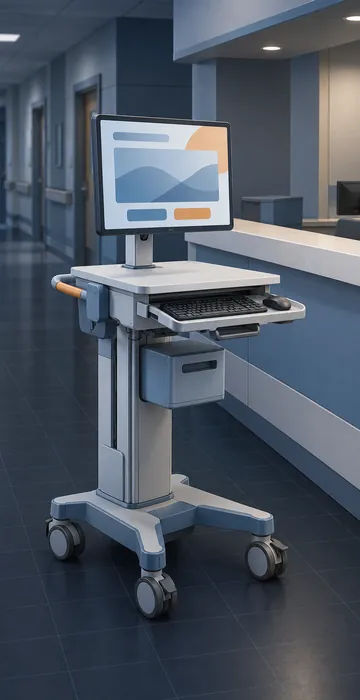
Good healthcare eLearning is designed for the places and devices staff actually use. That often means shared workstations, no speakers or headphones, and a login that times out quickly.
- Make audio optional. Provide on-screen text or captions so a module works in silence.
- Keep screens simple and readable on smaller monitors and tablets.
- Use realistic scenarios: the right patient name check, the right handoff, the right call.
- Use photos and examples from your own facility when you can, so it feels familiar.
- Write at a plain-language level that works for every role, not only clinicians.
Scenarios deserve special attention. A multiple-choice question about a policy number teaches very little. A short case where the learner chooses what to do when a visitor asks about a patient teaches a lot, and it's closer to the judgment calls staff make every day.
Which Healthcare Topics Work Best Online?
Knowledge-heavy and policy-based topics work very well online. Privacy rules, documentation standards, emergency codes, infection control principles and new policy rollouts are all strong candidates. Hands-on skills like starting an IV or operating new equipment still need supervised practice, but eLearning can prepare people for that session so the hands-on time goes further.
New hires are a great place to start. A blended onboarding path, with short online modules before the first shift and hands-on sessions with a preceptor after, gives people a calmer start. If you're building that kind of program, our guide to employee onboarding eLearning walks through structure, timing and measurement.
How Do You Know Healthcare Training Is Working?
Completion rates tell you training happened. They don't tell you it worked. To see real results, connect each program to something the organization already measures, and look at it before and after rollout.
For a hand hygiene refresher, that might be observed compliance from unit audits. For a documentation module, it might be the number of charts returned for corrections. For a privacy course, it might be the number of minor incidents reported and how quickly staff report them. Ask unit managers what they'd expect to see change, and agree on it before launch.
Don't forget the learners themselves. A two-question survey at the end ("Was this relevant to your job?" and "What's one thing you'll do differently?") gives you honest, quick feedback. Short comments from night-shift staff are often the most useful you'll get, because they're the people most likely to be left out of planning meetings.
Short Enough to Finish, Accurate Enough to Trust
Healthcare eLearning works when it respects the people taking it. Short modules fit real shifts. Clear ownership and review dates keep content correct. Role-based assignments and solid tracking keep you ready for any audit, without last-minute panic.
If you're not sure where to start, build your content register first. Listing every module, its owner and its next review date will show you quickly which courses need attention, and which ones your staff will thank you for fixing.