Off-the-Shelf vs Custom eLearning – Which Is the Better Buy?
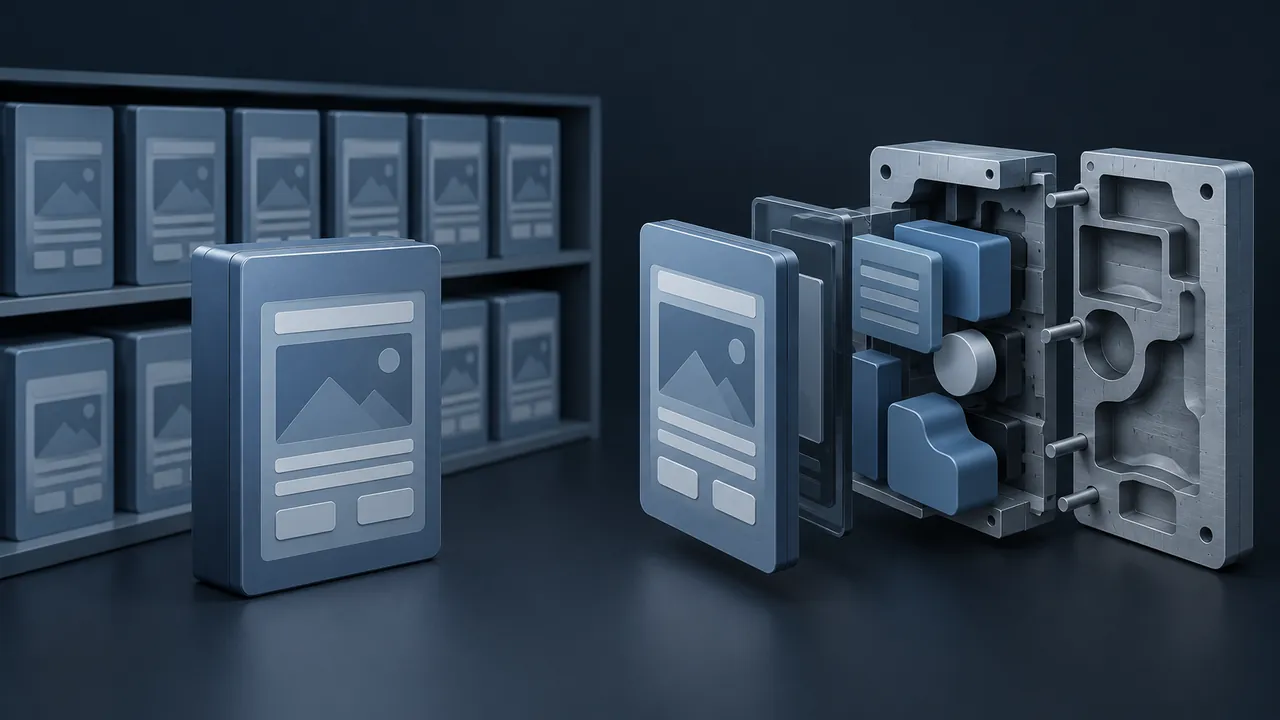
You have a training need, a budget and a deadline. One option is a ready-made course library you could activate next week, while the other is a course built around your people, your systems and your way of working, which takes months. The library is cheaper up front, the custom course fits better, and your finance partner wants a recommendation by Friday. So, off the shelf vs custom eLearning: which one is the better buy?
Off-the-shelf eLearning is the better buy for general skills that work the same everywhere, while custom eLearning is the better buy when the training depends on your own processes, products, systems or culture. Off-the-shelf is faster and cheaper per course, especially for small or mid-sized audiences. Custom costs more up front but can cost less per learner at scale, and it's far more likely to change specific on-the-job behavior. In practice, many organizations end up with a mix: a library for common topics and custom courses for the work that makes them different.
What's the Difference Between Off-the-Shelf and Custom eLearning?
Off-the-shelf eLearning is pre-built content you license, usually from a library provider, and custom eLearning is built from scratch for your organization. That simple difference shapes everything else: cost, speed, fit and who owns the result.
| Factor | Off-the-shelf | Custom |
|---|---|---|
| Up-front cost | Low, usually a license fee | High, paid as development |
| Time to launch | Days to weeks | Weeks to months |
| Fit to your work | Generic examples | Your systems, scenarios and language |
| Ownership | You rent access | You own the course and source files |
| Updates | Provider updates on their schedule | You update when you need to, at your cost |
| Cost pattern | Grows with learners and years | Mostly fixed after the build |
Neither column is better on every row, because the right choice depends on which rows matter most for this particular need.
When Is Off-the-Shelf eLearning the Better Buy?
Off-the-shelf is the better buy when the skill is the same in every organization, when you need it quickly and when your audience is small enough that per-learner licensing stays affordable.
Good candidates include software basics, general business skills like time management, generic leadership topics and some broad compliance awareness. These subjects don't change much from one company to the next, and providers have already invested in polished production, so building your own version of a solid spreadsheet course rarely makes sense.
Off-the-shelf also wins when the need is temporary or uncertain, since licensing a topic for a year is an inexpensive experiment if you're not sure people will use it. Most library content ships as standard packages, so check that it runs and tracks properly in your learning management system (LMS) before you sign. Rustici Software's plain-language guide, SCORM explained, is a helpful primer if your team needs to understand what "compatible" really means.
When Is Custom eLearning Worth the Extra Cost?
Custom eLearning is worth the extra cost when the training must reflect how your organization actually works, and when getting the behavior right matters more than checking a box.
- Your own software, equipment or procedures.
- Product knowledge for sales and support teams.
- Safety training tied to your specific sites and hazards.
- Onboarding that reflects your culture, values and real situations.
- Scenarios where learners must make the decisions your people actually face.
There's also a learner trust factor, because people notice when a course shows a generic office and generic problems, and they pay attention when the examples resemble their real work. That alone can be the difference between training that changes behavior and training that people click through.
My take: if the honest description of the skill includes the words "the way we do it here," you're probably looking at a custom build.
Off-the-Shelf vs Custom eLearning: Which Costs Less Over Time?
Which costs less over time depends mainly on the number of learners and the number of years. Off-the-shelf costs grow with every learner and every renewal, while custom costs are mostly paid once, plus maintenance.
The chart below is an illustrative example with made-up but plausible inputs, not market prices. It assumes an off-the-shelf license at $40 per learner per year and a custom course that costs $30,000 to build plus $3,000 a year to maintain, then shows the total three-year cost at different audience sizes.
Off-the-shelf at $40 per learner per year; custom at $30,000 build plus $3,000 per year upkeep; break-even at about 325 learners
- Off-the-shelf
- Custom
Illustrative example: inputs are assumptions chosen to show the break-even shape, not quoted prices.
View the data
| Off-the-shelf | Custom | |
|---|---|---|
| 100 learners | $12,000 | $39,000 |
| 200 | $24,000 | $39,000 |
| 300 | $36,000 | $39,000 |
| 400 | $48,000 | $39,000 |
| 500 | $60,000 | $39,000 |
| 600 | $72,000 | $39,000 |
With these inputs, the lines cross at about 325 learners. Below that point, off-the-shelf is cheaper, and above it, custom is cheaper over three years, with the gap widening quickly. The math is quick: custom totals $30,000 plus three years of $3,000, or $39,000. Off-the-shelf costs $120 per learner over three years. $39,000 divided by $120 is 325.
Substitute your real quotes and the crossing point moves, although the pattern rarely does. Big audiences and long time frames favor custom, while small audiences and short time frames favor the library. Keep in mind that library licenses often cover many courses at once, so spread the license cost across all the topics you'll actually use.
Is There a Middle Option?
Yes, there are middle options, and they're often the smartest buy. Three are common.

- Customized off-the-shelf. Some providers let you swap in your logo, terminology and a few scenarios for a fee. It's faster than custom and fits better than generic.
- Wrap-around content. License the generic course, then build a short custom module that shows how the skill applies in your organization. A 10-minute custom add-on can carry most of the relevance.
- Custom templates. Build a set of custom templates once, then produce many lower-cost courses with them. This works well for product training that changes often.
These hybrids let you concentrate custom budget where it changes behavior and save money everywhere else.
What Hidden Costs Come With Each Option?
Both options carry hidden costs that never appear on the first quote. Off-the-shelf hides them in time and renewals, while custom hides them in your own people's hours and in maintenance.
For off-the-shelf, watch for price increases at renewal, minimum seat counts, extra fees for reporting or customization, and the staff time it takes to curate a large library so learners can find what matters. A library of thousands of courses sounds generous, but someone has to decide which twenty your people should take. There's also an exit cost, because when the license ends, the content disappears along with any learning paths you built around it.
For custom, the biggest hidden cost is subject matter expert (SME) time. Experts have to explain the work, review scripts and test the course, often while doing their regular jobs. Maintenance follows, since whenever a procedure or system changes, someone has to update the course, and that cost lands on you rather than a provider.
Neither set of hidden costs is a reason to avoid an option. They're reasons to put realistic numbers in the comparison so the cheaper-looking choice doesn't surprise you later.
What Should You Ask a Library Provider Before You Sign?
Before signing with a library provider, ask about fit, data and flexibility. A short list of questions covers most of the risk.
- Can we preview full courses, not just trailers, with a few real learners?
- How often is the content reviewed and updated?
- Will completion and score data flow into our LMS reports?
- Can we hide courses, rename them or add our own introductions?
- What happens to our learners' records if we cancel?
A trial with ten or fifteen actual learners will reveal more than any sales demonstration, and if they shrug at the content during a free trial, they'll shrug at it when you're paying for it too.
How Do You Make the Decision?
You make the decision by scoring each training need on a few simple questions, then letting the answers point the way. Here's a quick screen you can run in a single meeting:
- Is the skill the same in every organization? If yes, lean off-the-shelf.
- Does it involve your own systems, products or procedures? If yes, lean custom.
- Will more than a few hundred people take it over several years? If yes, run the break-even math.
- Do you need it within a month? If yes, off-the-shelf or a hybrid.
- Will poor performance cause safety, legal or customer harm? If yes, custom is usually worth it.
Once you've decided to build something custom, you'll need to find the right partner. A well-written eLearning RFP gets you comparable quotes and saves weeks of back-and-forth.
Whatever you choose, plan to measure it. Track completion, but also track whether people do the job differently afterward. That's the only way to know next year whether the buy was a good one.
The Better Buy Is the One That Changes the Work
Off the shelf vs custom eLearning isn't a battle with one winner. Off-the-shelf is the better buy for generic skills, quick launches and smaller audiences, while custom is the better buy when the work is specific to you, the audience is large or the stakes are high.
Run the break-even math with real quotes, consider a hybrid, and spend custom money where it changes behavior. Then measure the results, so the next decision is based on evidence instead of a hunch.